
Login or create an account
CloseReturning Customer
I am a returning customer
Login or create an account
CloseRegister Account
If you already have an account with us, please login at the login form.
Your Account Has Been Created!
Thank you for registering with puregradepeptides!
You will be notified by e-mail once your account has been activated by the store owner.
If you have ANY questions about the operation of this online shop, please contact the store owner.
Account Logout
You have been logged off your account. It is now safe to leave the computer.
Your shopping cart has been saved, the items inside it will be restored whenever you log back into your account.
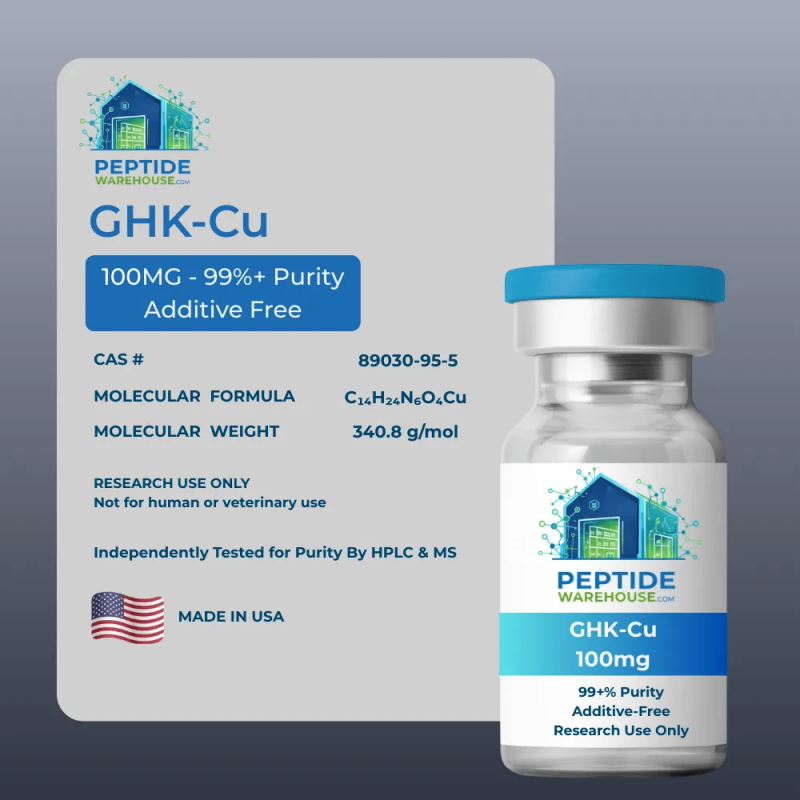
GHK-Cu – Research-Grade Copper Tripeptide Complex (Gly–His–Lys–Cu²⁺)
GHK-Cu, commonly referred to as copper tripeptide-1, is a coordination complex formed between the tripeptide sequence Gly–His–Lys (GHK) and a divalent copper ion (Cu²⁺). This compound has been extensively described in scientific literature as a structurally defined metal–peptide complex with physicochemical properties distinct from the unchelated GHK peptide. In controlled laboratory environments, GHK-Cu is utilized as a research material for studying metal–peptide coordination, copper-dependent biochemical interactions, and peptide-mediated signaling models.
Unlike simple peptide blends, GHK-Cu represents a single chelated molecular entity in which copper coordination influences conformation, stability, and analytical behavior. This characteristic makes it a useful tool for investigating metal-binding dynamics, peptide–metal complex formation, and downstream structure–function relationships in vitro. Its defined composition and consistent chelation profile support use in mechanistic assays, comparative metal–peptide studies, and exploratory biochemical research conducted under controlled laboratory conditions.
Related research compounds
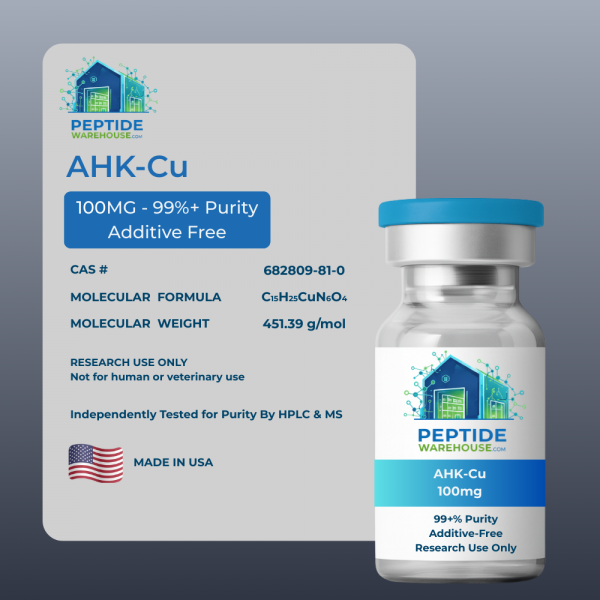
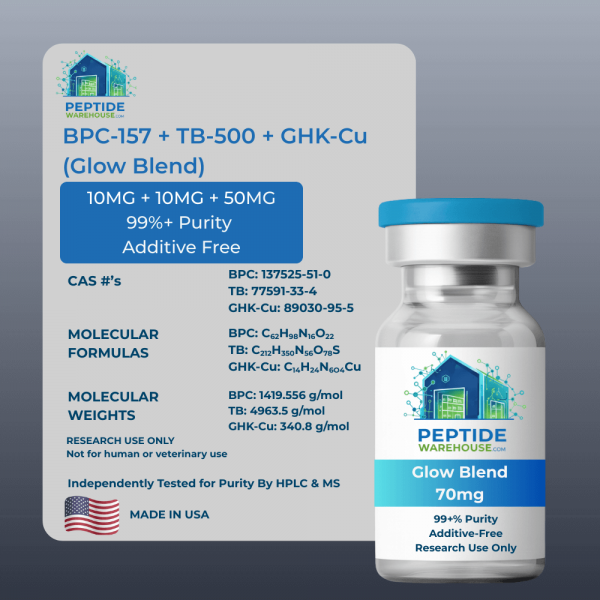
AHK-Cu · Matrixyl · SNAP-8 · BPC-157 + TB-500 + GHK-Cu (Glow Blend) · BPC-157 + TB-500 + GHK-Cu + KPV (KLOW Blend)
Documentation and methods
Analytical testing · How to read a COA · Batch COAs · Storage and handling · What are research peptides
Research guide GHK-Cu — structure, classification and analytical characterizationImportant Information About This Research Product
- 1 Your vials are not empty. The lyophilized material may collect at the bottom of the vial and can appear minimal prior to inspection.
- 2 All products are supplied as lyophilized (freeze-dried) powder and require reconstitution. Bacteriostatic water is not supplied.
- 3 Store in a dry, cool, and dark environment away from UV exposure. For optimal preservation, storage at approximately 4°C is recommended.
- 4 This material is strictly for laboratory and research use only. No instructions regarding reconstitution, dosing, or administration can be provided.